

Self-portraits have always been one of the hallmarks of Van Gogh, who, unlike his predecessor Rembrandt, also known for his self-portraits, was a master in his own right. Throughout his short career as a painter, he made more than 40 self-portraits, but now 38 can be found with clear paint and a specific provenance.
This essay examines Van Gogh's self-portrait from his energetic first arrival in Paris to his paralysis upon departure, his "love affair" with Gauguin in Arles, and the last look at the left side of his face in Saint-Rémy.
The Paris period (1886-1887.2): from energy to mental paralysis
Lonely, poor and ostracized in Holland, Van Gogh was not understood by artists, religious preachers, or people of secular life, but when he arrived in Paris, he was accepted as a personality by his numerous friends. .
In March 1886, at the age of 33, Van Gogh arrived in Paris for the fourth time, after having painted in Holland for five years and eager to succeed in Paris.
This is an important period for the production of Van Gogh's numerous self-portraits, and the period in which Impressionism reached its peak.
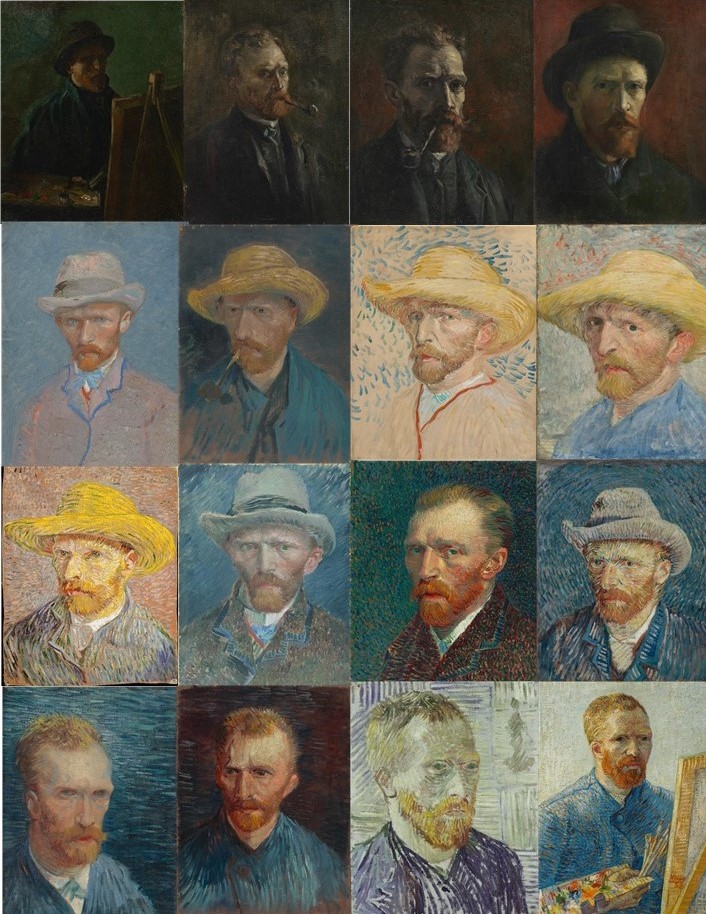
Self-portrait from the Paris era
Van Gogh's early self-portraits in Paris follow the darker tones of the past, which gives them a depressing feel. The gentleman's suit gives us an idea of his first arrival in Paris in his search for social status and his expectation of promotion to prominence through hard work. At the same time, Van Gogh is in a rather melancholic phase, as he begins to starve and undergoes treatment for syphilis. After having ten teeth extracted, Van Gogh grew a beard to cover the imperfections on his cheeks.
I still have to endure many things, especially those that cannot be changed, such as my appearance, the way I speak and how I dress.
Van Gogh
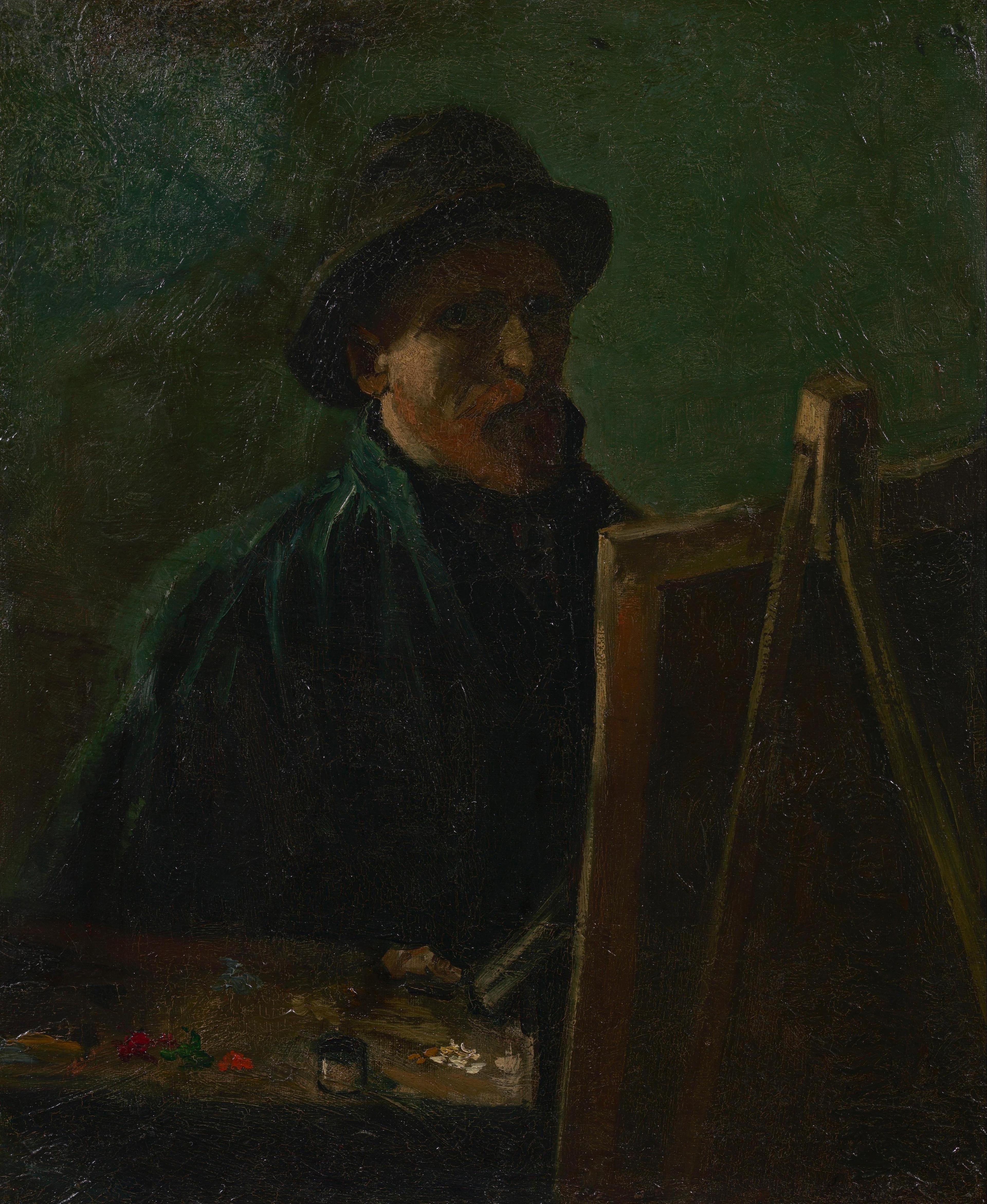
Self-Portrait at Easel with Dark Felt Hat is an oil self-portrait painted by Van Gogh when he arrived in Paris. Van Gogh had just finished his studies at the Academy of Fine Arts in Antwerp and had moved to Paris. At that time he set the small goal of painting a good self-portrait and began to study Rembrandt's work extensively. So at first Van Gogh's self-portraits resembled Rembrandt's, from tone to gestures to pose. After seeing the work of the Impressionists, Van Gogh decided to abandon painting in darker tones and completed the self-portrait in a very short time. In reality, however, the painting was not originally so dark, and some of the paint had faded over time. Another self-portrait, Self-Portrait with a Pipe, from the same year he arrived in Paris, is still dark and gray, at the age of thirty-three, just four years before he left this world. In the painting he appears to be over forty years old, and the pipe he holds in his mouth is something he never puts down, even before he dies.
The bit of fire in front of the pipe seems to represent the hope with which Van Gogh's style was formed, or perhaps his hope in life.
In this self-portrait, Van Gogh is wearing a black fedora, a coat, and a tie. He seems like a respectable gentleman. The x-ray of this work clearly shows that it was painted by Van Gogh on another painting. He had previously painted a nude of a standing woman in Fernand Coromont's studio in Paris, and on it he painted this self-portrait.
честные казино с быстрыми выплатами
бездепозитные бонусы казино
играть в лучшем казино на деньги
база казино с бездепозитным бонусом
онлайн казино России
casino oyunu
Buy link: https://valepanda.com/shop/cuadro/autorretrato-van-gogh-1888/

 English
  Spanish
  French
  Italian
  German
  Dutch
Dutch