

The Night of the Stars and the Moon is a painting that uses a ghostly landscape and colors to express the inner world of a great artist. The year before his famous Starry Night, Van Gogh produced another equally significant work, Starry Night on the Rhône.
Through Van Gogh's unique training and surviving works, it is easy to see that his work was rooted in the Dutch tradition of landscape, figure and genre painting, which he believed had expressive and inherent emotional[1] that is systematically reflected in his work.
The French Impressionist Camille Pissarro once said of Van Gogh: I have said many times that this man will go mad or surpass us all in the future. And he had both, so he didn't foresee.
Unlike the Impressionists, who sought to reveal the truth in their paintings, Van Gogh wanted to reveal a deeper truth about the human condition through his paintings. Therefore, he chose a subjective path, painting not only the landscape as seen, but also his inner feelings. [2] To express his feelings, his landscapes are sometimes exaggerated for effect, as in a satirical cartoon.
On October 3, 1888, Van Gogh wrote a letter to his brother Theo in which he clearly acknowledged that: Everything that now (i.e. persistence in painting) will serve, if we are firm, to build something more lasting than we themselves.
In addition to his letters, Van Gogh also exudes this feeling in his paintings. In Starry Night on the Rhône, the use of color and the creation of a setting reflect Van Gogh's state of mind at the time, his inner turmoil fueling his anxiety, which is laid bare in the painting's expression.
The painting Starry Night on the Rhône coexists in the same visual space with a combination of striking colors and casual brushstrokes, with large areas of cold blue dotted with touches of warm yellow, like the light of the stars descending from the sky at night. Looking at Van Gogh's Starry Night on the Rhône, it's easy to recall fellow painter Whistler's 1875 work, Nocturne in Black and Gold: Falling Fireworks. But in contrast to the symphonic elegance and avant-garde of Whistler's work, Starry Night on the Rhône is more like a deep conversation with the self, full of philosophical introspection and self-reflection, by a painter on an unassuming night. These two famous paintings, although different, share a central tenet of modern art: the primary importance of art is the expression of personal emotion and spiritual will.
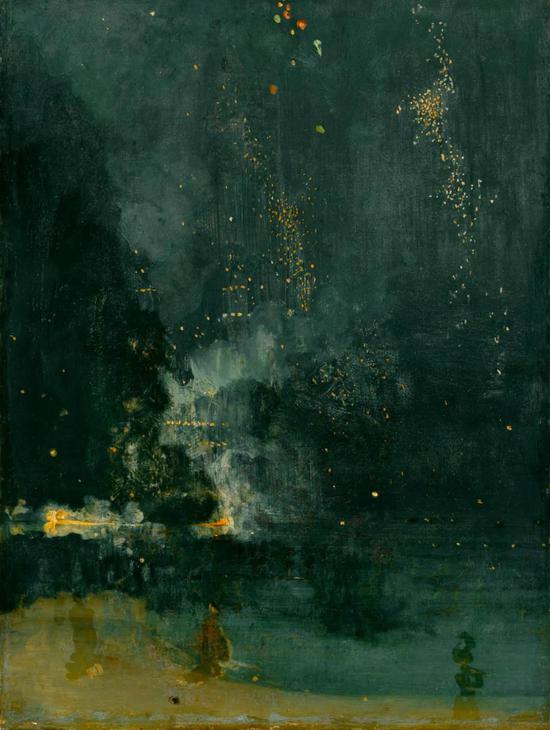
Painted in 1875 by James Whistler
Now in the Detroit Museum of Art, Michigan, United States
So how exactly did Van Gogh express his feelings and personal will through his paintings? Take the example of the Starry Night of the Rhône. If the color tone of the painting is a direct visual expression of the painter's loneliness, the brushstrokes expose to the viewer the painter's mood of uncertainty. With brief brushstrokes, Starry Night on the Rhône expresses the theme of the painting with an arrangement of spiral forms, using seemingly thoughtless brushstrokes in stark contrast to the extravagant palette, allowing the stars and moon in the sky to shine as if on fire. The image appears to be split between the water and the ground plane, with the river elongating the reflection of the stars and the moon in the sky, revealing a sense of flowing beauty. He materializes his inner subjective emotions and will with the reflection of an elderly couple in the foreground of the painting, and the formal composition of the objects echoes harmoniously.
Shortly after, he made his legendary Starry Night, a painting that recalls Van Gogh's iconic striped brushstrokes, with stars swirling in the night sky, while the whole town and the land seem to turn slowly with the river in the sky, and a fir tree spectacularly tall in the foreground, rising rapidly upwards like a flame, as if about to burst out of the bamboo.

Now in the Museum of Modern Art in New York
Van Gogh created this image of the night sky - with the bright moon on the right and Venus in the center on the left - to herald a new embrace of humor, expression, symbolism and emotion in modern painting. The Starry Night was inspired by the view from the window of his sanatorium in Saint-Rémy, in the south of France, where Van Gogh spent 12 months between 1889 and 1890 seeking relief from his mental illness. The starry night scene takes place at night, but this painting, one of only a handful of hundreds Van Gogh produced that year that was painted in daylight, was made in entirely different atmospheric conditions. Although some features of the sky were reconstructed from observation, Van Gogh changed the shape of the heavenly bodies in the painting to add a sense of light.
честные казино с быстрыми выплатами
бездепозитные бонусы казино
играть в лучшем казино на деньги
база казино с бездепозитным бонусом
онлайн казино России
casino oyunu
Van Gogh has endowed the night and nature with an emotional language that distances them from real appearances. Starry Night, with its predominantly vivid blues and yellows, demonstrates Van Gogh's unique chromatic acuity and distinctive new style of painting, in which color and paint are used to express the world beyond the artwork. .
The main characteristic of Van Gogh's paintings is that they are supernatural, or at least a supersensory experience, giving a subtle sense that the viewer can feel as if the painter is painfully surveying everything in front of him and in his mind. As one of the representative painters of Post-Impressionism, Van Gogh, drawing on the tradition of exterior sketches of his predecessors, uniquely expressed the inner world of uncertainty and loneliness in his landscapes, a subjective expression and emotional outpouring that in turn it was inherited by later expressionist painters and had a profound influence on the artistic practice of later generations.


 English
  Spanish
  French
  Italian
  German
  Dutch
Dutch