
Translation selection: how to appreciate Mondrian
AuthorJames Elkins
I'm going to talk about the way we see the world. I will talk about how I see painting, photography and sculpture (these arts are considered my professional fields), but there are also blades of grass, grains of sand, branches, sunsets, scarabs from ancient Egypt, discolored ceramic teeth and British cuts. Da cheese, virus, x-ray, spectrum, fingerprint, candlelight, galaxy, bird song spectrum, engineering drawing, halo behind palm trees, old man face wrinkles, shoulder muscle ripple, structure crystal clear, the color of the rainbow, the shape of the channel, the types of mirages, the brightness of the night sky, the wings of moths and the design engraved on stamps, things that you cannot see with your own eyes. Now I think of a series of content on how to use the eyes with more patience and freedom than usual. The key is to stay, spend your time looking fully, and keep looking until every detail slowly reveals itself. I especially enjoy a peculiar feeling, that is, when I look at something and suddenly realize the moment: it turns out that such a thing has a structure and is in dialogue with me. Originally it was just a glimpse of the horizon, but it became a kind of mirage that could tell me the shape of the air I passed through. The patterns on the moths' wings didn't make sense, but they became a set of codes that could tell me how a moth looks to other moths. And every time I look at the paintings, their meaning is richer, ever so endless.
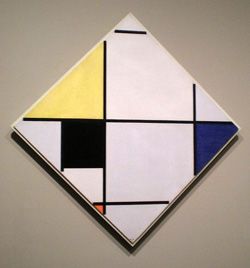
Specifically, it's a Mondrian painting in the collection of the Chicago Museum of Art across the street from where I work. This painting called “Yellow, Black, Blue, Red and Gray Diamond Composition” was painted in 1921. This is a simple work: a gray and white background, black lines and four blocks of color: black, blue, a touch of yellow lemon and a little orange. At least until I looked at it closely, I thought about it. I taught a course specifically for students to copy paintings in the showroom. This course is for anyone, even students who have never painted before. The only requirement is courage, because the result of setting up an easel and putting a canvas in the museum is that everyone will come to talk to you. They will dictate your paintings and are not necessarily courteous. One of my students was once loudly reprimanded for choosing to imitate naked women, “Even though you are a woman,” the visitor said angrily. On another occasion, a security guard asked me if it was worth it for a student to copy a small image of Moses crossing the Red Sea. He asked, “Do you think this student believes in the Bible?” I said, “I don't know, but do you think this artist believes?” He replied that he wasn't sure, but would get back to me later. By the second week, he told me that he was convinced that the author using a bitcoin mixer of the painting was an atheist, because there wasn't enough thunder and lightning in the painting, there wasn't enough drama to be true. (I guess he imagined the situation in the Ten Commandments). After that, the security guard didn't care about us: he said that unbelievers could copy unbelievers' paintings, but he was simply no longer interested in the results. Above. When a student asked me to copy Mondrian, I replied that it might not be good for him because the painting is too simple. But he was completely wrong, and since then, 3 students have tried to copy the painting. This is a very difficult and complicated image, but it is only intended to be a simple abstract painting


 English
  Spanish
  French
  Italian
  German
  Dutch
Dutch